|
||
| Sulphuric Acid on the WebTM | Technical Manual | DKL Engineering, Inc. |
Knowledge for the
Sulphuric Acid Industry

Sulphuric Acid on the Web
Introduction
General
Equipment Suppliers
Contractor
Instrumentation
Industry News
Maintenance
Acid
Traders
Organizations
Fabricators
Conferences
Used
Plants
Intellectual
Propoerty
Acid
Plant Database
Market
Information
Library
Technical Manual
Introduction
General
Definitions
Instrumentation
Plant Safety
Metallurgial
Processes
Metallurgical
Sulphur Burning
Acid Regeneration
Lead Chamber
Technology
Gas Cleaning
Contact
Strong Acid
Acid Storage
Loading/Unloading
Transportation
Sulphur
Systems
Liquid SO2
Boiler Feed Water
Steam Systems
Cooling Water
Effluent Treatment
Utilities
Construction
Maintenance
Inspection
Analytical Procedures
Materials of Construction
Corrosion
Properties
Vendor Data
DKL Engineering, Inc.
Handbook of Sulphuric Acid Manufacturing
Order
Form
Preface
Contents
Feedback
Sulphuric Acid
Decolourization
Order Form
Preface
Table of Contents
Process Engineering Data Sheets - PEDS
Order
Form
Table of Contents
Introduction
Bibliography of Sulphuric Acid Technology
Order Form
Preface
Contents


Acid Plant Database July 6, 2026
| Owner | EuroChem |
|
| Location |
14 kilometers southwest of Zhanatas Sarysu District Zhambyl Region Kazakhstan |
|
| Background | ||
| Website | www.eurochemgroup.com | |
| Plant | ||
| Coordinates* |
43° 31' 28" N, 69° 33' 46" E |
|
| Type of Plant | Sulphur Burning | |
| Gas Source | Elemental Sulphur | |
| Plant Capacity | 800,000 MTPA | |
| SA/DA | DA | |
| Status | Operating | |
| Year Built | 2026 | |
| Technology | Catalyst Supplier: Wylton Catalyst | |
| Contractor | ||
| Remarks | ||
| Pictures |
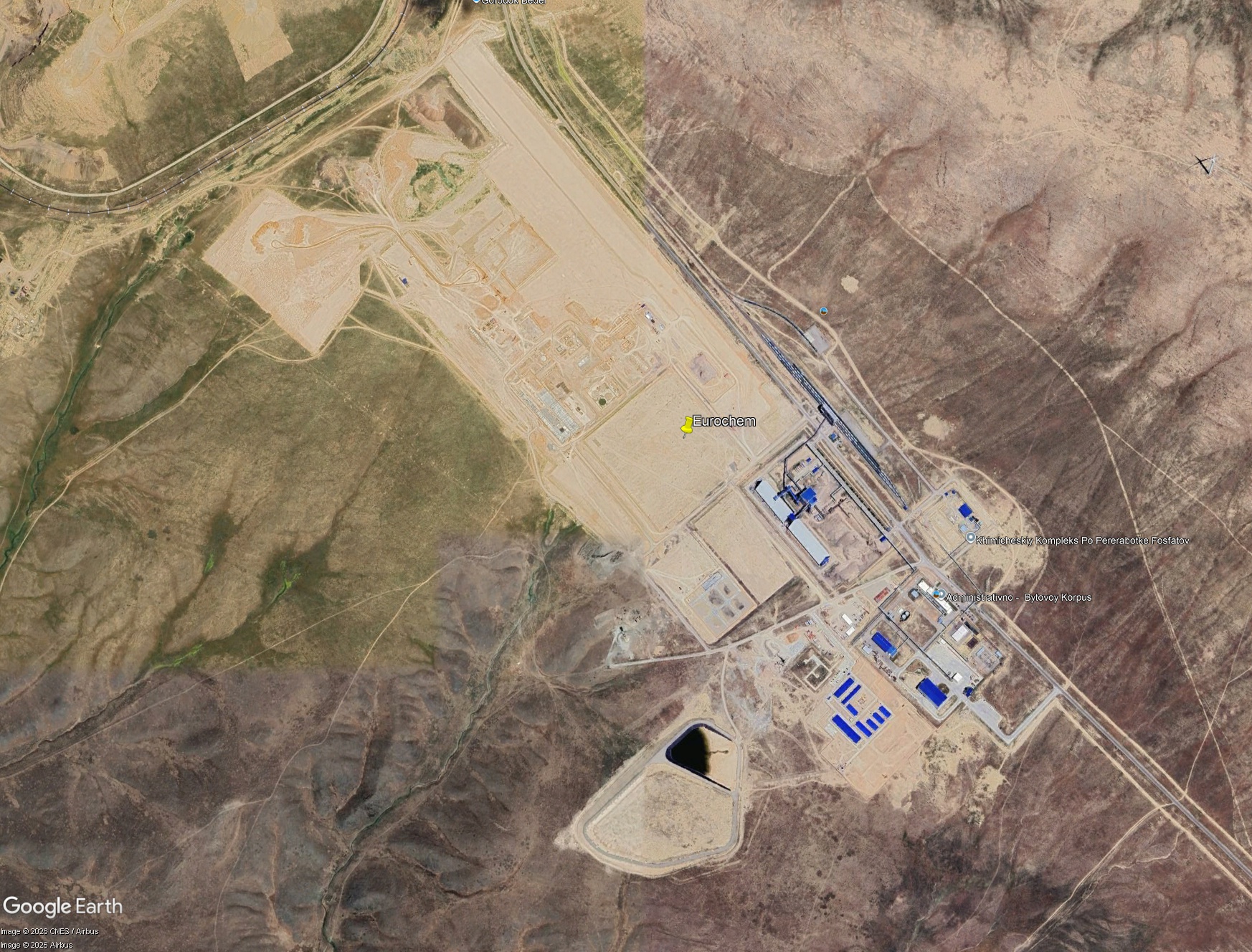 |
|
| General | ||
| Videos | ||
| References | ||
| News |
May 27, 2026 - The Company has
put into operation a sulfuric acid production plant in the Zhambyl Region of
the Republic of Kazakhstan. The facility ranks among the largest of its kind
in the country with an annual design capacity of 800,000 tonnes. The plant’s
products will be used both for the EuroChem’s chemical complex under
construction and to meet the needs of the domestic market in Kazakhstan.
The launch of the plant is Phase II of EuroChem’s large-scale investment
project in Kazakhstan. In Phase I, the Company launched a phosphate ore
mining and processing complex with an annual capacity of 840,000 tonnes. The
final Phase III will be the launch in 2027 of a chemical complex for the
production of mineral fertilizers and industrial products. Total investments
exceed $1 billion, while total annual output upon completion of all Phases
will be more than 1 million tonnes. The project is being implemented
under the Unified Industrialization Map of Kazakhstan.
"The project is fully aligned with the strategic
goals set by the President of the Republic of Kazakhstan to develop the
manufacturing industry, diversify the economy and ensure the country’s
economic self-sufficiency. The launch of high-tech production facilities
serves as a prime example of strengthened industrial cooperation and
strategic partnership between our nations. I am confident that once the
project reaches it’s full capacity, it will make a substantial contribution
to the economic development of Kazakhstan", (Yersaiyn Nagaspayev Minister of
Industry and Construction of the Republic of Kazakhstan) Following the completion of all Phases, the
Zhambyl Region will have one of the few full-cycle chemical production
facilities in the world, where raw material extraction, processing and
production of finished goods are integrated into a single production chain.
The complex’s products will be in demand not only in Kazakhstan but also
across other countries in Central Asia, China and European markets. "The project implements state-of-the-art
high-tech solutions that guarantee quality and safety. EuroChem intends to
continue investing in the development of its production facilities and
strengthening its partnership with the agro-industrial complex of
Kazakhstan" (Igor Georgiadi CEO of EuroChem Karatau) The project is significantly important for the
social and economic development of the region. Total tax revenues to the
budget of Kazakhstan have already reached approximately 70 billion tenge
during the implementation of the project. Upon completion of all Phases,
over 1,200 jobs will be created within the Company, with at least an equal
number in related service and logistics organizations. Since 2012, EuroChem
has invested approximately $29 million in the development of social
infrastructure of the Zhambyl Region, including renovations of residential
buildings, schools, healthcare facilities and urban infrastructure. May 26, 2026 - A ceremony was held at the EuroChem-Karatau production site in the Sarysu district of the Zhambyl region to mark the launch of a sulfuric acid plant with a capacity of 800,000 tons per year. This event marked the completion of the first stage of the second phase of one of Kazakhstan's largest industrial projects, with a total investment of up to $1 billion. The project is being implemented with the assistance of KAZAKH INVEST NC JSC. The ceremony was attended by Yerbol Karashukeyev, Akim of the Zhambyl Region; Yersaiyn Nagaspayev, Minister of Industry and Construction of the Republic of Kazakhstan; Nurgazy Anuarbek, Managing Director of KAZAKH INVEST NC; Igor Akhmerov, General Director of EuroChem PMU LLC; Igor Georgiadi, General Director of EuroChem-Karatau LLC; and representatives of government agencies, the business community, and international organizations. The project's history spans nearly two decades. Initiated in 2008, it has evolved from the initial geological surveys to a fully-fledged chemical production facility. Development of the Karatau phosphorite deposit began in 2012, and the mining plant—the first stage of the project — was commissioned in 2016. The intergovernmental agreement on the implementation of the second stage was ratified by the President of the Republic of Kazakhstan in January 2022, after which construction of the chemical plant immediately began. Today's launch of the sulfuric acid production facility is the first stage of this large-scale project. The general EPC contractor was CNCEC, a leading Chinese engineering company specializing in chemical projects. A distinctive feature of the project is the use of environmentally friendly technologies. Unlike traditional phosphorus production, which produces phosphogypsum, EuroChem's technology involves the production of calcium chloride and synthetic gypsum — products in demand in construction, the agro-industrial complex, and other sectors of the economy Construction and installation work for the second stage of the plant is underway at all production facilities and is 72% complete. Commissioning is scheduled for the first quarter of 2027. Once fully operational, the plant will produce up to 1 million tons of products annually, including dicalcium phosphate (200,000 tons), potassium sulfate (260,000 tons), calcium chloride (130,000 tons), and synthetic gypsum (320,000 tons). The project's implementation is having a significant impact on the socioeconomic development of the Zhambyl region. EuroChem currently employs over 1,000 people, with service and outsourcing companies providing approximately 300 additional jobs. Up to 2,000 people are currently involved in the active construction phase. Once the complex is fully operational, at least 1,200 new permanent jobs will be created. By the end of 2025, phosphate production volume will reach 890,000 tons, valued at 17 billion tenge, and in the first four months of 2026, approximately 345,000 tons of the product will be produced, valued at 8 billion tenge. November 27, 2024 - EuroChem Karatau, a subsidiary of the Russian EuroChem, plans to launch a fertilizer manufacturing facility in the Zhambyl region in February 2027. According to a statement published by the company, the approximate timeline for the project is 24 months. Construction is expected to start in the first quarter (March) of 2025 and finish in the first quarter (February) of 2027. Once completed, the plant will operate until 2052-2053, when its equipment will have to be replaced. The fertilizer manufacturing plant will consist of a sulfuric acid plant (SAP Plant) with a capacity of 800,000 tons per year, a potassium sulfate production facility (SOP Plant) with a capacity of 260,000 tons per year, a calcium hydrogen phosphate plant (DCP Plant) with a capacity of 200,000 tons per year, and a calcium chloride facility (CaCl2 Plant) with a capacity of 130,000 tons per year. The plant is expected to be launched in two stages. The first stage, which is the SOP Plant, should be commissioned at the end of 2025, while the second phase — fertilizer production — will be launched in 2027. |
|
MTPD - Metric Tonne per Day
STPD - Short Ton per Day
MTPA - Metric Tonne per Annum STPA - Short Ton per
Annum
SA - Single Absorption
DA - Double Absorption
* Coordinates can be used to
locate plant on Google Earth